William C. Head, P.C.
Atlanta DUI Law Firm



By: Bubba Head, Atlanta DUI Lawyer with 47 years of DUI Defense Experience

Many clients call our Atlanta law office in a panic: “I just got arrested; what are the odds of getting my DUI charges dropped?” Well, that’s hard to answer completely, as each case and circumstance is different.
Being arrested for DUI in Georgia is serious, but it doesn’t mean a conviction is inevitable. Many DUI cases have weaknesses that an experienced Atlanta DUI lawyer can expose, leading to possible charge reductions or outright dismissals.
But what we can tell you are the common legal defenses that may have a chance of getting your GA DUI dismissed, including breathalyzer errors, illegal DUI stops, and violations of Georgia’s implied consent law. Also, in this article, our top Atlanta attorneys explain the potential penalties that accompany a misdemeanor DUI charge.
Yes, DUI charges can be dismissed in Georgia—but it depends entirely on the specific facts of your case. While Georgia has one of the highest DUI conviction rates in the country (over 95%), first-time offenders have the best chance of getting charges dropped, especially when no aggravating factors are present.
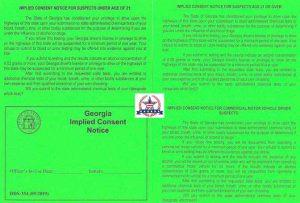
Many dismissals result from procedural mistakes, such as illegal stops, faulty test results, or violations of Georgia’s implied consent law. Under O.C.G.A. § 40-5-67.1, officers are required to read the Implied Consent Notice immediately after arrest. Below is a picture of the impleid consent notice. This warning explains that, by driving in Georgia, you consent to chemical testing—and refusal can result in an automatic one-year license suspension. Below is the exact Implied Consent Notice Georgia officers are required to read after arrest. If this wording was misread, skipped, or the wrong version was used (there are 3), it could be a grounds to suppress BAC evidence.
You also have a legal right to request an independent test after submitting to the officer’s choice of chemical test. If your request is ignored or unreasonably delayed, your attorney may argue that your rights were violated—further weakening the State’s case.
Here are some of the most common legal issues that may lead to a dismissal in Georgia DUI cases:

When dismissal isn’t an option, other favorable outcomes—like charge reduction or a not guilty verdict—can still protect your future. Here’s how we evaluate the best path forward.
The best possible outcome in a Georgia DUI case is a full dismissal of the charges. This typically happens when key evidence—such as breath or blood test results—is suppressed due to an illegal stop, testing errors, or a violation of Georgia’s implied consent law. If the judge excludes that evidence, the State may have no case left to prosecute.
If a full dismissal isn’t possible, the next best option is a reduction to reckless driving, which avoids many of the long-term consequences tied to a DUI conviction. Reckless driving is still a misdemeanor, but it doesn’t trigger an automatic license suspension, DUI school, or enhanced penalties for future DUI arrests. This option is often available to first-time offenders, especially when no aggravating factors are involved.
Finally, if your case goes to trial and the prosecution fails to prove impairment beyond a reasonable doubt, the judge or jury must find you not guilty. While taking a case to trial carries more risk, it’s sometimes the best path when the State’s evidence is weak or flawed.
Our firm’s priority is to avoid a DUI conviction whenever possible—whether through dismissal, reduction, or a trial win.
Watch the video below as Attorney Bubba Head explains how we evaluate each case and build a defense strategy tailored to achieving the best possible outcome.

A first-time DUI conviction in Georgia typically results in a mix of license suspension, fines, probation, and mandatory DUI education. However, the exact outcome varies depending on your BAC level, whether there were aggravating factors, and whether you have any prior offenses.
A first-time DUI sentence in Georgia may include the following penalties:
GEORGIA DRIVERS, BE AWARE OF THIS: If you’ve been arrested for DUI in Georgia, you only have 30 days from the date of your arrest to take action to protect your driver’s license. If you miss this deadline, your license can be automatically suspended—even before your case is resolved in court.
To fight this suspension, you must file DDS Form 1205 and request a hearing through the Administrative License Suspension (ALS) process with the Office of State Administrative Hearings (OSAH). This hearing is your opportunity to challenge the suspension and make your case for keeping your driving privileges.
There is a $150 filing fee required to request this hearing, and payment must be submitted along with your request.
A DUI attorney can help you correctly complete and file the necessary documents, submit payment, and represent you at the ALS hearing to give you the best chance of success.

A reduction to reckless driving is a common alternative when the DUI evidence is weak. This section explains when prosecutors are most likely to consider that option.
While a full dismissal is ideal, it’s not always possible. In some cases, the most strategic outcome is negotiating a reduction to reckless driving—a lesser charge that avoids the long-term penalties of a DUI conviction.
Reckless driving is still a misdemeanor under Georgia law, but it doesn’t trigger an automatic license suspension or require DUI school. It also avoids DUI-specific consequences like enhanced penalties for future offenses, high-risk insurance classification, or employment restrictions.
Prosecutors may agree to a reduction when the evidence is weak—for example, if your BAC was close to the legal limit of 0.08%, no accident occurred, and there were no aggravating factors. If the officer failed to follow proper procedures, mishandled chemical tests, or misread the Implied Consent Notice, your attorney can use those issues to push for a lesser charge.
Every case is different, and there’s no guarantee a reduction will be offered. But for many first-time offenders, reckless driving can be a highly favorable alternative to a DUI conviction.

There’s no one-size-fits-all defense in a Georgia DUI case. The most effective defense strategy depends entirely on the specific facts of your arrest, including the type of DUI charge, the reason for the stop, and how the evidence was obtained.
For example, if you were charged with DUI Per Se—which means you submitted to a chemical test and your blood alcohol concentration (BAC) was over the legal limit—then your defense may center on the accuracy of that result. Breathalyzers must be properly calibrated and administered under strict protocols. Environmental factors, improper testing procedures, or machine malfunction can all lead to false readings, which may be challenged in court.
On the other hand, if you’re facing a DUI Less Safe charge, where the officer relied on observed driving behavior and field sobriety tests to claim you were impaired, the defense may focus on how subjective and unreliable those tests are. Poor lighting, medical conditions, or even nerves can affect how someone performs on these roadside exercises, and officers often make mistakes when administering them.
Regardless of the charge, how the arresting officer handled your implied consent rights is also critical. If the implied consent notice was not read properly, read too late, or omitted entirely, your attorney may be able to file a motion to suppress any test results obtained afterward.
Ultimately, the best DUI defense comes down to identifying legal or procedural errors that create reasonable doubt or exclude key evidence. In the next section, we break down the specific types of evidence prosecutors rely on—and how a skilled defense attorney may be able to challenge it.

In Georgia, the length of time a DUI case can remain open depends on two important phases: when charges are filed, and what happens after they are.
Under O.C.G.A. § 17-3-1, the statute of limitations for filing DUI charges is two years for a misdemeanor and four years for a felony DUI. That means the prosecution must formally file charges within that time window, starting from the date of the alleged offense—not the arrest. If they miss that deadline, the case can no longer proceed legally, and the charges must be dismissed.
However, once charges are filed—even on the last possible day—the statute of limitations no longer applies. At that point, there is no fixed deadline for resolving the case. It can stay “open” for months or even years, depending on court scheduling, motions filed by either side, and the complexity of the case.
For many people, this raises stressful questions—especially if they were arrested but haven’t heard anything yet. If it’s been close to or beyond two years without formal charges, an attorney can help you confirm whether the statute of limitations has expired and if the case should be dismissed.
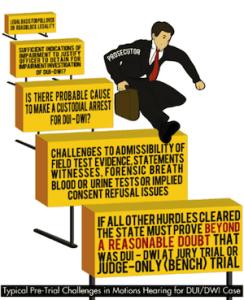
To convict someone of DUI in Georgia, the prosecution must prove beyond a reasonable doubt that the driver was either impaired or had an illegal blood alcohol concentration (BAC) while operating a vehicle.
Georgia recognizes two main types of DUI charges: DUI Per Se, based on a BAC over the legal limit, and DUI Less Safe, based on officer observations and alleged signs of impairment. For DUI Per Se, the State must show that your BAC was above 0.08% (or 0.04% for commercial drivers and 0.02% for those under 21). For DUI Less Safe, no BAC is required, the State instead relies on how you were driving, how you acted during the stop, and your performance on field sobriety tests.

While this evidence may sound straightforward, it’s often far from reliable. Breath and blood test results can be flawed due to improper calibration, mishandled samples, or violations of Georgia’s implied consent law. Field sobriety tests, which are used in DUI Less Safe cases, are highly subjective and can be influenced by fatigue, anxiety, or medical conditions.
Ultimately, what the prosecution presents as “proof” often leaves room for reasonable doubt—especially when an experienced DUI defense attorney investigates how that evidence was collected.

The best plea in a Georgia DUI case depends on the strength of the evidence and the specific facts of your arrest. Most cases begin with one of three plea options: not guilty, guilty, or nolo contendere (no contest).
Pleading not guilty gives your DUI defense attorney time to challenge the evidence, file suppression motions, and negotiate for a lesser charge, like reckless driving. It also keeps the option of going to trial open.
A guilty plea means you accept the charge and the penalties under O.C.G.A. § 40-6-391, which include possible jail time, license suspension, fines, and DUI school.
A nolo contendere plea means you’re not admitting guilt but accepting the punishment. While Georgia allows this plea, most judges do not accept it for DUI charges, making it a limited option.
Unlike some states, Georgia does not offer a formal “wet reckless” plea as a standard alternative to DUI. However, a reduction to reckless driving can serve a similar purpose, allowing you to avoid DUI-specific consequences while still resolving the case.

A first-time DUI in Georgia is classified as a misdemeanor, but that doesn’t mean it’s minor. That said, not all DUI cases end in the harshest outcome. In many first-offense cases, especially where no aggravating factors are involved, defense attorneys are able to negotiate for a more favorable result.
Dismissals or reductions are possible when the arrest involves weak evidence, procedural errors, or borderline BAC levels. In cases where a full dismissal isn’t realistic, many first-time offenders are eligible for reduced charges, such as reckless driving. These outcomes can avoid the long-term consequences of a DUI conviction, like license suspension, increased insurance premiums, or employment barriers.
Even if a conviction occurs, most first-time DUI defendants avoid extended jail time, and instead receive a combination of probation, community service, and mandatory DUI school.

Being arrested for DUI in Georgia doesn’t mean you’ll be convicted. Many cases involve legal errors that can be challenged, like faulty breath tests, officer mistakes, or violations of Georgia’s implied consent law. But acting quickly is critical: you have only 30 days to request an ALS hearing before your license is automatically suspended.
A conviction can impact your job, your insurance, and your ability to drive, but you may be eligible for reduced charges or alternatives to DUI penalties, especially if this is your first offense.
Lead attorney William “Bubba” Head is a nationally recognized DUI defense lawyer with over 47 years of experience. He’s joined by Larry Kohn, a seasoned attorney with more than 40 years in DUI law, and Cory Yager, a former police officer who now defends Georgia drivers with deep knowledge of DUI procedures. Together, our attorneys have handled thousands of DUI and traffic cases throughout Georgia.
We literally wrote the book on Georgia DUI law, publishing the state’s leading legal guide on DUI defense strategies in 2024. The sooner you contact us, the more options you’ll have.
Call 404-567-5515 now for a free, no-obligation consultation with a criminal lawyer Atlanta GA, or complete our confidential online contact form.