William C. Head, P.C.
Atlanta DUI Law Firm




Georgia record restriction is the legal process that shields a prior arrest from public view on a criminal background check. Georgia does not offer true expungement. Instead, under Georgia's record restriction statute, you may be able to restrict access to the criminal history records held by the Georgia Crime Information Center (GCIC). Once restricted, the arrest no longer appears on a standard employer or landlord background check. Judicial officials and criminal justice agencies can still see the record.
Many people search for "expungement" when what Georgia law actually provides is record restriction. The distinction matters. True expungement destroys the record entirely. Georgia record restriction seals it from public access. It keeps the record for law enforcement purposes. This article explains who qualifies, how to make the request, and what to do if the prosecutor denies it.

Record restriction is not the only route. A first drug charge resolved by conditional discharge never becomes a conviction in the first place.
Record restriction is Georgia's method for removing an arrest from public criminal history databases. A court or a prosecutor approves the restriction. The GCIC then blocks the arrest record from showing up on a standard background check. Employers, landlords, and the general public can no longer see it.
The governing law never uses the term "expungement." It speaks only of "restrict" and "restriction." The legislature overhauled the process in 2013. The statute still treats July 1, 2013 as the dividing line. Before that change, Georgia offered a limited form of expungement.
Reform then came in stages. Governor Nathan Deal signed Senate Bill 367 in 2016. That reentry package updated the First Offender Act and limited how a licensing board may weigh an old conviction. Then in 2020, lawmakers opened a route for certain misdemeanor convictions after a four-year wait.
A restricted record does not vanish. Judicial officials and criminal justice agencies keep access for law enforcement and criminal investigative purposes. A criminal justice agency may also use the record for its own hiring. A prosecutor, a public defender, and a sentencing court can still see it. Licensing and regulating agencies do not receive a restricted record. Disclosures that federal law requires are unaffected. A restricted record can still cost you some jobs and public offices.
The restriction applies to arrest records held by the GCIC. It also applies to records held by the arresting law enforcement agency. A county or municipal jail restricts its own records only if you ask it to in writing.
Record restriction reaches criminal history records. It does not reach your driving record. DDS Georgia keeps that history on its own, and a restriction order does not change it.
Once a record is restricted, the GCIC must notify the arresting agency within 30 days. That agency then has 30 days to restrict its own records. A jail or detention center has 30 days to act on your written request.
For arrests on or after July 1, 2013, the GCIC restricts a qualifying case without any request from you. Older arrests work differently. So do the conviction groups added later. There you must ask for restriction, and a prosecutor or a judge decides.
The written-request process below is the route the statute gives for arrests that happened before July 1, 2013. Later arrests are restricted at the close of the case. The conviction groups added in 2020 need a petition to the court where the case was handled. Missing a step can delay or block approval.
Request a criminal history report from the GCIC. This confirms the arrest appears on your record. The report shows every arrest sent to the state database. It also shows how each one ended.
Obtain the record restriction form from the arresting law enforcement agency. The request must be in writing, on a form approved by the GCIC.
File the completed form with the arresting agency. The agency has 30 days to forward a copy to the prosecuting attorney. Reasonable fees for the actual cost of restricting the records may apply. The statute caps that fee at fifty dollars.
The prosecuting attorney has 90 days to review the request. The prosecutor checks it against the statutory criteria. A denial must cite a specific reason. If the prosecutor never answers within those 90 days, the statute presumes no objection.
If the prosecutor approves, you submit the approved request to the GCIC. The GCIC restricts access within 30 days. The arresting agency restricts its own copy within 30 days of the prosecutor's decision. The whole process can still take several months. Much depends on the county and the prosecutor's workload.
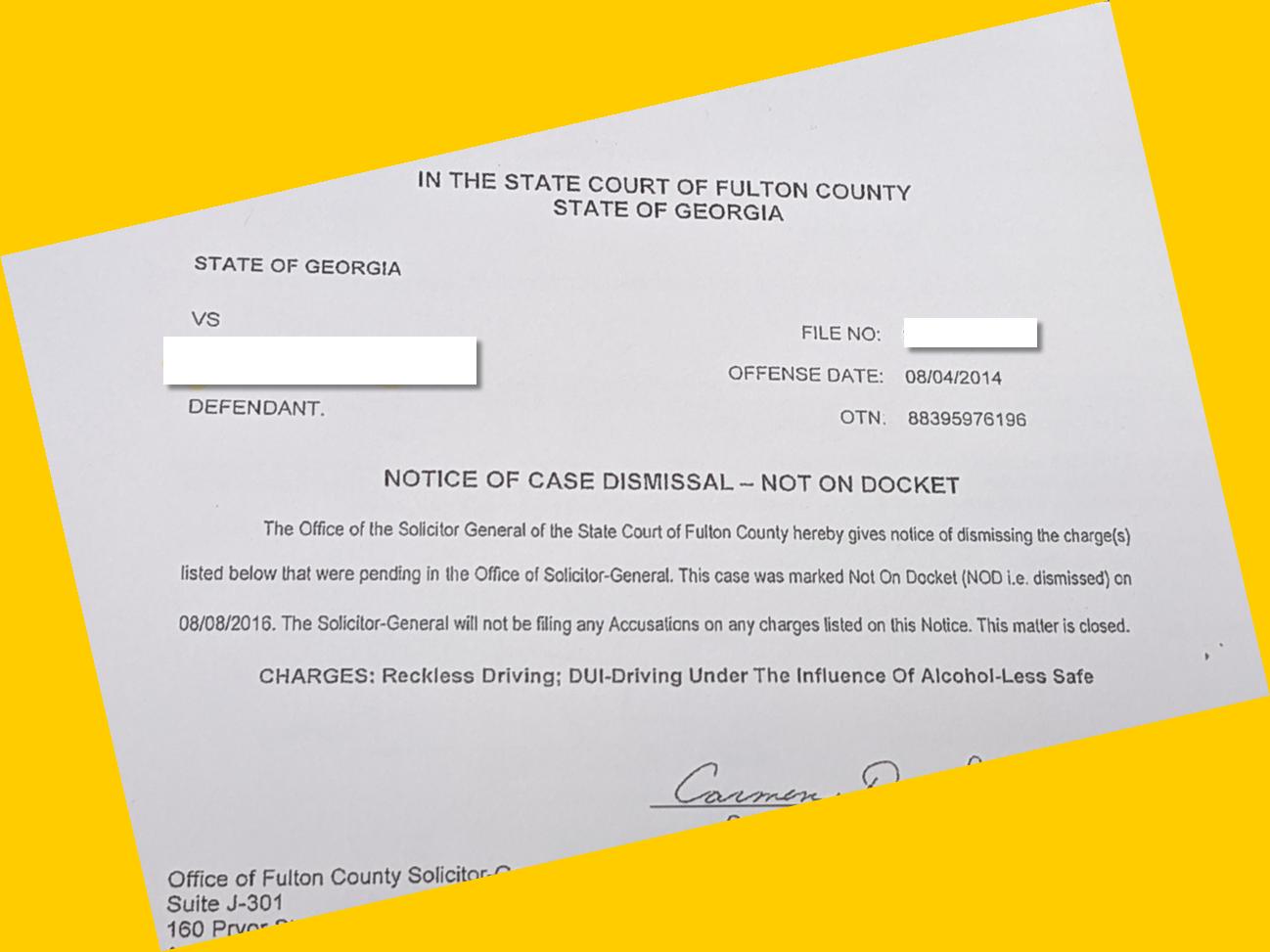
Important: A DUI conviction cannot be restricted. DUI is a serious traffic offense, and the statute's misdemeanor restriction route excludes every serious traffic offense. A nolo contendere plea to DUI in Georgia does not help, because it is not a dismissal, a nolle prosse, or an acquittal. Say a DUI charge was reduced to a lesser offense such as reckless driving. The arrest record stays visible: a reduction counts only when the charge becomes a local ordinance violation. A DUI arrest that ended in a complete dismissal or acquittal may qualify. There must be no conviction on any charge arising from the same incident.
Not every arrest qualifies for Georgia record restriction. Much depends on how the case was resolved. The type of offense matters too.
The main group covers arrests that did not end in a conviction. If the charges were dismissed, the case qualifies. It also qualifies if the charges were nolle prossed, the prosecutor's formal decision to drop them. A charge that has sat on the dead docket for more than 12 months can be taken to the court by petition, and the judge decides. An arrest the grand jury no-billed twice qualifies. So does a single no bill once the waiting period has run. Where the arresting agency never sent the case to a prosecutor, that period is two years for a misdemeanor. It is four years for most felonies. It is seven years for a serious violent felony or a felony sexual offense against a child under 16. The statute treats dismissals before an indictment or accusation differently from those after, and post-indictment dismissals face added scrutiny.
A nolle prosequi does not always clear the record. The prosecutor can block restriction by stating that the case was dropped because of a plea deal that convicted you of a related charge. Suppression of material evidence is another listed ground. So is conduct that was part of a pattern of criminal activity prosecuted in another court. So is immunity from prosecution.
Since 2020, certain misdemeanor convictions can also be restricted. You must have completed the sentence. You must have gone four years with no new conviction. You must have no pending charges. The court decides, and the relief is capped at two convictions in a lifetime. The excluded list is long. It takes in family violence offenses, most theft, sexual offenses, and any serious traffic offense. The rule applies to sentences imposed before, on, or after July 1, 2020. This change gave many Georgians a path to clear old misdemeanor records that had no remedy before.
A person granted a pardon from the State Board of Pardons and Paroles may also petition for restriction. The offense cannot be a serious violent felony or a sexual offense. There must be no conviction since the pardon was granted, apart from a minor traffic offense. There must be no pending charges.
Several groups remain ineligible. A DUI conviction cannot be restricted, and neither can a nolo plea to DUI. Convictions for serious violent felonies and sexual offenses stay on the record even after a pardon. An arrest on one of those charges can still be restricted when the case ends without a conviction. Pending charges block the conviction-based petitions. Each situation is different. Talk to an attorney about your own facts before you file.

Yes. Georgia law gives you a way to challenge the denial, though it is not an appeal by certiorari. If the prosecuting attorney declines your request, you may file a civil action in the superior court. The right court is the one where the agency holding the record sits. A copy goes to that agency and to the prosecuting attorney, and both may become parties.
The burden is yours, and it is a heavy one. The prosecutor's decision stands unless you show two things by clear and convincing evidence. First, that the arrest is eligible. Second, that the harm to your privacy clearly outweighs the public interest in the record staying public. If you win, you submit the court's order to the GCIC, which restricts the record within 30 days. If you lose, the rejection stands and the record stays open.
The statute sets no deadline for that civil action, so do not read a thirty-day rule into it. A thirty-day deadline does govern a different challenge. Say you asked the agency holding the record to correct information that is inaccurate, incomplete, or misleading. If it refused or let 60 days pass, you have 30 days to appeal to the court with original jurisdiction over the offense. The filings are technical. Many people benefit from working with an attorney who knows the record restriction statute and local court practice.
Larry Kohn is an experienced record restriction attorney from our criminal defense law group. Our attorneys work to save you time and cost. We help you avoid disappointment when Georgia record restriction law is difficult to work with.
Georgia is strict about clearing an adult conviction. The statute does open a few narrow doors. A conditional discharge in a drug case can be restricted. So can a first underage alcohol charge handled under the Code section written for it. So can a case dismissed after you complete drug court, mental health court, or veterans court. A DUI reaches none of them, because first offender treatment does not apply to a DUI conviction at all.
Other valuable insights on this website:
The Georgia record restriction process is paper-heavy and prosecutor-driven. A missing form can delay or block approval. An incomplete criminal history report can also hold up your request. A misreading of the statutory criteria can end in a denial. Once denied, your only route is a civil action in superior court, and the burden of proof there is yours.
An attorney who knows the record restriction statute can review whether you qualify. The attorney can prepare the paperwork. The attorney can handle the back and forth with the prosecuting attorney's office. If the prosecutor denies your request, an attorney can file the superior court action for you.
William C. Head, PC offers a free consultation. Call 404-567-5515 to speak with a Georgia criminal defense attorney about whether your arrest may qualify for restriction.

Georgia's record restriction statute never uses the word "expungement." Since the 2013 overhaul, the process is called record restriction. Record restriction seals a record from public view. It keeps the record open to the courts and to criminal justice agencies. True expungement destroys a record entirely. Georgia does not offer true expungement.
A DUI conviction cannot be restricted, because the statute excludes every serious traffic offense from the misdemeanor restriction route. A nolo contendere plea to DUI does not qualify either, since it is not a dismissal or an acquittal. If you were arrested for DUI and the charges were completely dismissed, you may qualify for restriction of the arrest record. You may also qualify if you were acquitted with no conviction on any related charge.
Timelines vary by county. On a written request for an arrest before July 1, 2013, the prosecuting attorney has 90 days to review it. Once a record is restricted, the GCIC must notify the arresting agency within 30 days. The agency has another 30 days to restrict its records. The full process may take several months.
Yes, for most purposes. A restricted record will not appear on a standard employer or landlord background check. The statute also keeps it away from licensing and regulating agencies. Criminal justice agencies and the courts still see it. Disclosures that federal law requires are unaffected, and a restricted record can still cost you some jobs and public offices.
Judicial officials and criminal justice agencies keep access to restricted records for law enforcement and criminal investigative purposes. A criminal justice agency may also use the record for its own hiring. A prosecutor, a public defender, and a sentencing court can see it. The restriction blocks private persons and businesses, and it blocks licensing and regulating agencies.