William C. Head, P.C.
Atlanta DUI Law Firm




A first-time DUI in Georgia is a misdemeanor under Georgia's DUI statute. It carries jail time, fines, mandatory probation, community service, and a driver's license suspension. A Georgia drunk driving conviction creates a permanent criminal record. This record cannot be expunged, sealed, or restricted under the state's First Offender Act.
Other states call the same offense "DWI" (driving while intoxicated), "OUI," or "OWI." The label differs, but the underlying charge is the same. If you were arrested in Georgia, your citation reads "DUI." The term used elsewhere does not change the charge you face.
Unlike states that offer diversion programs or record-sealing for first-time impaired driving charges, Georgia bans these options for DUI. A conviction stays on your criminal history for life. It affects insurance rates, employment, military eligibility, and professional licensing.
This article covers the full penalty structure for a first DUI offense in Georgia. Topics include jail time, fines, probation, and license consequences. It also covers implied consent rules, high BAC situations, DUI versus DWI terms, and how to fight the charge.



According to WalletHub, a first offense DUI conviction in Georgia can result in some of the nation's toughest overall punishments. Only Arizona is more punitive. This is due to Georgia's "no expunction" rule. Georgia applies this rule to first DUI offenses and all subsequent offenses.
Georgia law does not allow sealing of DUI records, withholding judgment, diversion, conditional discharge, or use of the First Offender Act on DUI convictions. No record restriction or expungement is available to hide the DUI from your criminal record.
Beyond the permanent criminal record, loss of your plastic driver's license occurs at conviction. Georgia licensees age 21 and over may apply for a limited driving permit during the 12-month suspension. They must have had no DUI arrest in the previous five years. At the end of 120 days they may apply to Georgia DDS for early reinstatement. That requires proof of completion of a DUI Risk Reduction Program and a $210 restoration fee ($200 by mail). Non-resident drivers lose the right to drive in Georgia for one year. They may attend a Georgia risk reduction course. They may also attend a comparable course in another state. Reinstatement of Georgia driving privileges after 120 days requires that same course and restoration fee. The home state then applies its own rules to the license it issued.
Under Georgia's DUI statute, a first DUI conviction in Georgia carries these mandatory penalties:
Jail time. The statute sets imprisonment at not fewer than 10 days and not more than 12 months. A judge may suspend, stay, or probate most of that time. If the driver's alcohol concentration was 0.08 grams or more, the judge must impose at least 24 hours of actual incarceration. In most cases, time served on the night of arrest counts toward this requirement.
Fines. The fine runs from $300 to $1,000, and it cannot be suspended, stayed, or probated except under the statute's hardship and treatment provisions. State surcharges and add-ons often double the out-of-pocket amount beyond the base fine.
Probation. If the jail sentence is fewer than 12 months, the court must impose probation. The probation period equals 12 months minus any days actually served in custody. Probation conditions can restrict travel, and military recruiters generally will not enlist an applicant who is still serving a sentence.
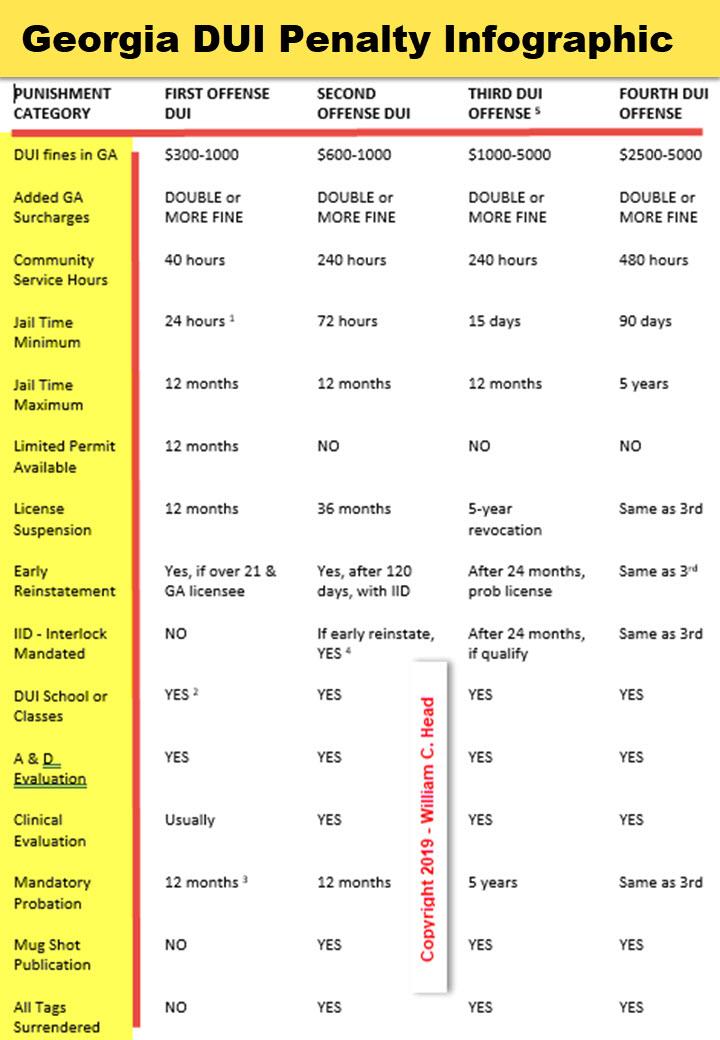
Community service. A minimum of 40 hours of community service is required. The minimum drops to 20 hours only for a driver under 21 convicted under Georgia's zero-tolerance provision whose alcohol concentration was below 0.08 grams.
DUI Risk Reduction Program. Completion of a DUI Alcohol or Drug Use Risk Reduction Program is mandatory within 120 days of conviction. If the defendant is incarcerated and cannot finish within 120 days, the program must be completed within 90 days of release.
Clinical evaluation and treatment. A clinical evaluation is required. If the evaluation recommends substance abuse treatment, the defendant must complete the recommended program. The court may waive the evaluation at its discretion.
License suspension. A first DUI conviction suspends the driver's license for 12 months, with early reinstatement available after 120 days. Georgia-licensed drivers age 21 and over may be eligible for a limited driving permit. This permit allows travel to work, school, medical appointments, and court-ordered programs.

Implied consent laws in Georgia are strict. They call for a one-year hard suspension if an administrative license suspension for a DUI refusal occurs following a DUI arrest. Under Georgia's implied consent statute, an implied consent law is a DUI-related statute. It takes away driving privileges for arrested drivers who say no to a post-arrest blood, breath, or urine sample.
Here is how the process unfolds after a Georgia DUI arrest. The arresting officer places the driver in handcuffs. The officer then reads a card called an implied consent notice. The notice tells the arrested person that continued driving privileges in Georgia depend on saying yes to a post-arrest test of a bodily substance. Any refusal results in issuance of a DDS-1205 driver license suspension form. That form starts a 30-day clock, running from the date the notice is served. Within that window the driver may request a hearing, or install an ignition interlock device for a year if eligible.
Georgia law also provides an ignition interlock option under Georgia's ignition interlock statute. This option applies to most Georgia licensees who are age 21 and over. They must be facing a first DUI in five years, measured by dates of arrest. The department cannot issue an ignition interlock device limited driving permit to anyone under 21. It also cannot issue one to anyone not currently licensed in Georgia. It cannot issue one to anyone holding a commercial driver's license. It cannot issue one to anyone whose license is suspended for a traffic accident that caused injuries or fatalities.
The consequences depend on whether the driver refused or submitted to testing:
Refusing the state-administered chemical test. A refusal triggers a one-year hard suspension with no limited driving permit available. The exception is an ignition interlock device limited driving permit, applied for within 30 days of the implied consent notice. The refusal to submit to blood or urine testing may also be offered into evidence against the driver at trial.
Submitting to testing and blowing over the limit. If the test shows an alcohol concentration of 0.08 grams or more, the department suspends the driver's license, subject to review. For drivers under 21, the threshold is 0.02. For commercial vehicle operators, the threshold is 0.04. Drivers who submitted to testing often have broader options. They can seek a limited permit or challenge the suspension at an administrative hearing.
The driver has 30 days from the date the notice is served. In that time the driver may request an administrative hearing, with a $150 filing fee, or apply for the interlock permit. Missing this deadline may result in automatic suspension. The administrative hearing examines whether the officer had reasonable grounds for the arrest. It also examines whether the implied consent notice was properly read. It looks at whether the driver refused or failed the test.
The Georgia Supreme Court's 2019 decision in Elliott v. State also affects how implied consent plays out. That ruling addressed the state constitutional limits on compelled breath testing. Defense attorneys may raise Elliott-related challenges depending on how testing was requested or administered. The specifics vary case by case, making qualified legal counsel important in any implied consent dispute.


Georgia does not have a separate "high BAC" or "aggravated DUI" statute. Some other states do set a high BAC first offense as its own sentencing tier with enhanced mandatory minimums. Georgia's first-offense penalty structure contains no such tier.
Under Georgia's DUI statute, the statutory penalties for a first DUI apply regardless of whether the BAC was 0.08 or 0.25. However, a BAC of 0.15 or higher still drives harsher real-world outcomes in several ways.
Judges have wide leeway in sentencing first offenders. When the BAC is well above the legal limit, judges often impose more jail time beyond the 24-hour minimum. They impose longer or stricter probation conditions. They impose more intensive treatment requirements after the clinical evaluation. Some prosecutors will not negotiate a reduction to reckless driving or another lesser offense when the BAC reading is high.
Ignition interlock device requirements also become more likely. While the interlock is not statutorily mandated for a first conviction, courts may impose it as a condition of a limited permit or probation. A very high BAC level strengthens the court's rationale for requiring one.
From a defense standpoint, a high BAC first offense makes challenging the test result more important. Breath testing machines have known sources of error. These include mouth alcohol contamination, improper calibration, and operator mistakes. Field sobriety tests are open to challenge as well, since the officer scores them from personal observation. Blood tests can be challenged on chain-of-custody grounds, improper storage, or lab procedure errors. When the BAC number is the strongest proof, challenging it is worth more. This is especially true when that number is very high.
If you were arrested with a BAC at or above 0.15, consult a Georgia DUI defense attorney promptly. The 30-day implied consent deadline and the harder line prosecutors take make early action critical.

Georgia's impaired driving statute uses the term "DUI" – driving under the influence. Many other states use "DWI" (driving while intoxicated), "OUI" (operating under the influence), or "OWI" (operating while intoxicated) for the same conduct. A Maine OUI lawyer, for example, defends the same conduct under Maine's OUI label. A California DUI lawyer works under the same three letters Georgia uses. In Michigan the charge is an OWI, which is what a Michigan OWI lawyer defends. North Carolina calls it a DWI first offense in NC. If you search for "first offense DWI" and were arrested in Georgia, the charge on your citation reads DUI. The same goes for a search like "DWI: 1st offense" – a first DWI offense in another state is the same conduct Georgia charges as a DUI.
The underlying elements are the same regardless of the label. Georgia law prohibits operating a motor vehicle while impaired by alcohol, drugs, or a combination. It also prohibits operating with a blood alcohol concentration at or above the per se limit. Georgia sets these per se alcohol-concentration limits:
A BAC chart lays these limits out side by side, and Georgia DDS publishes its own DUI and BAC chart. A first offense DWI in another state and a first offense DUI in Georgia carry different penalties. Each state sets its own sentencing structure. If you hold an out-of-state license and are convicted of DUI in Georgia, the federal driver license reporting law has Georgia report that conviction to the National Driver Register. Your home state checks that register before it issues or renews a license. It then applies its own rules for license suspension, insurance consequences, and record treatment.
For Georgia residents, the penalty structure for a first DUI is the same whether called a DUI or a DWI. The fines, jail exposure, probation, community service, risk reduction program, and license suspension described in this article all apply.
The total cost extends far beyond the courtroom fine. State surcharges and add-ons roughly double the base fine amount. You also face DUI school fees, license reinstatement fees, clinical evaluation and counseling costs, and significantly increased auto insurance premiums. The total out-of-pocket cost over the first three years after conviction often runs between $4,000 and $9,000. The exact figure depends on the case. For those who fight the charges, legal fees for experienced counsel may exceed $10,000. Expert witness costs and motion practice drive that number.
Yes, conviction results in jail time. Under Georgia's DUI statute, when the driver's alcohol concentration was 0.08 grams or more, the judge must impose at least 24 hours of actual incarceration. In most cases, time spent in custody on the night of arrest counts toward this requirement. Judges have discretion to impose more jail time depending on the circumstances. If a DUI charge is reduced to a lesser offense such as reckless driving, jail time is often not required.
A drunk driving conviction in Georgia is permanent. The state does not allow expungement, record restriction, record sealing, diversion, or First Offender Act treatment for any DUI conviction. This applies to first offenses and all subsequent offenses. The conviction stays on both your criminal history and your driving record for good.
A high BAC first offense generally refers to a DUI arrest where the driver's blood alcohol concentration is 0.15 or higher. Some states codify this as a separate, more severe charge with enhanced mandatory penalties. Georgia does not have a separate high BAC tier. However, judges exercise discretion in sentencing. A very high BAC reading often leads to more jail time, stricter probation conditions, and stronger resistance from prosecutors to negotiate a charge reduction.
In Georgia, yes. The state's impaired driving statute uses "DUI" (driving under the influence). Other states call the same offense "DWI" (driving while intoxicated), "OUI," or "OWI." If you were arrested in Georgia, the charge is DUI. The term you heard elsewhere does not change the charge. The penalties, license consequences, and defense strategies are the same regardless of which label applies.
A drunk driving conviction often causes a sharp rise in auto insurance premiums. Some insurers also require a certificate of financial responsibility on file before they will keep writing the policy. Insurance companies treat drunk driving as a high-risk sign. Rate increases often last three to five years or longer. Some insurers may cancel your policy altogether. You would then need coverage from a high-risk carrier at much higher cost.
Yes. Because a Georgia DUI conviction cannot be expunged, it shows up on background checks for good. This may affect current jobs and future job applications. It may also affect professional licensing (nursing, teaching, law, commercial driving) and military service. Military recruiters generally will not enlist an applicant who is still serving the probation a DUI sentence carries. Holders of a commercial driver's license face separate disqualification rules that may be more severe.
Federal law has Georgia report the DUI conviction to the National Driver Register, which your home state checks. Your home state then applies its own rules for license suspension and other consequences. Non-resident drivers lose the right to drive in Georgia for one year following a conviction. They may attend a Georgia risk reduction course or a comparable course in their home state. Georgia driving privileges can be reinstated after 120 days once that course is complete and the restoration fee is paid.
A first drunk driving charge in Georgia carries consequences that follow you for life. Georgia offers no expungement, no diversion, and no first-offender treatment for DUI. The outcome of this case matters more than in almost any other state.
When choosing a defense attorney, look for a lawyer whose practice focuses on Georgia DUI defense. Look for a lawyer who knows the administrative license suspension process, the 30-day implied consent deadline, and motion practice in Georgia courts. That knowledge matters. Ask whether the attorney is prepared to litigate suppression motions and take your case to trial if that serves your interests.
William C. Head, PC offers free consultations around the clock for first-offense DUI charges in Georgia. Call 404-567-5515 or use the online contact form to discuss your case with a Georgia DUI defense attorney. Every case is different. The facts of your arrest may present defenses that only a qualified lawyer can identify.