William C. Head, P.C.
Atlanta DUI Law Firm



Field sobriety tests are designed for the driver to FAIL! Roadside DWI testing starts when police use a three-test battery on a DUI suspect. The battery falls into two groups. One is a psycho-physical test (the HGN eye test) and the other two (walk-and-turn and one-leg-stand) are divided attention tests. None of the 3 police tests prove sobriety or lack of sobriety. That fact is your starting point for debunking the NHTSA field sobriety test "battery" of roadside tests. Burns, Moskowitz, and others ran the original 1977 studies at the Southern California Research Institute. They studied about a dozen divided attention tasks. Dr. Burns then studied the horizontal gaze nystagmus test. That test tracks eye changes that alcohol CAN cause at certain BAC levels. That medically-based test joined the battery in 1981.
At a roadside pullover for a traffic ticket or at DUI checkpoints, no medical doctor or eye doctor examines you. No one measures the extent of any nystagmus. No one with medical training uses horizontal gaze nystagmus to predict a patient's BAC alcohol level. Police press a suspected drunk or drugged driver to take roadside screening tests. NONE OF THEM is mandatory. By asking to FIRST speak to a lawyer, you can stymie their efforts. Police know that you can WITHDRAW the request for an attorney, and some keep trying to get you to self-incriminate. All that is required from you is NAME and ADDRESS. Knowledgeable criminal defense lawyers tell clients to use every right they have. Both the federal US Constitution and the Georgia Constitution supply those rights.
These roadside tests are the first tier of what most drivers call DWI testing. The one leg stand test is scored much like the walk and turn test. The NHTSA participant manual lists four (4) validated clues for it. The suspect sways while balancing, uses arms for balance, hops, or puts the raised foot down. Two or more of those four clues are scored as a failure. Officers are trained to have you hold one foot about six inches off the ground and count out loud for roughly 30 seconds.
Here is the contrast that matters most in Georgia. Declining the roadside tests carries no automatic license suspension. Refusing the state-administered chemical test is a different choice. That request follows the implied consent rights the officer reads, and it carries license penalties. The Georgia Constitution also protects you from being compelled to perform a self-incriminating act. Art. I, Sec. I, Para. XVI. A driver may politely decline the roadside tests. A driver may also ask to speak with a lawyer first.
You would not let a police officer give you a "sports" exam or a pelvic exam. So you should not let one give you a MEDICAL test that creates "junk science" "evidence" for use against you in a criminal case. These tests are VOLUNTARY. No penalty for your driver's license will follow. The Georgia Constitution also lets you refuse any act that can self-incriminate you. Art. 1, Section 1, Paragraph 16. Your well-trained DUI attorney will explain the real purpose. Police use this DUI screening test to prop up a shaky arrest. These graded tests become a major part of the case against you. Georgia calls that charge DUI less safe. This "unscientific" guesswork by police of DUI field test results is barely regulated. Its only role is to justify a DUI less safe arrest. In most drunk driving arrests, the HGN test is flawed.
The NHTSA-standardized walk-and-turn test has eight (8) validated clues. Under NHTSA scoring rules, an officer marks the test "failed" when a suspect shows two (2) or more of those eight clues.
Drivers who ask how many clues in walk and turn scoring exist are surprised by how short the list is. The NHTSA participant manual sets out the clues for walk and turn in this order:
Many people search instead for the 9 step walk and turn clues. That name comes from the instructions. The officer tells you to take nine heel-to-toe steps down a real or imagined straight line. You then turn with a set series of small steps. Then you take nine heel-to-toe steps back. The 9 step walk and turn clues are these same eight scored clues.
Every number above comes from the NHTSA manual, not from our firm. The tally means nothing unless the officer gave and scored the test exactly as trained.
Two clues out of eight. That count is the answer to how many clues to fail walk and turn tests under NHTSA scoring rules.
That cutoff is not a scientific finding about impairment. Researchers picked it so the test would match a target blood alcohol number in NHTSA-funded studies. The accuracy numbers officers quote in court come from three studies. Burns and Moskowitz did the 1981 work at the Southern California Research Institute. A 1983 field study and a 1998 San Diego field study followed. Each reported a link to a BAC number, as measured in that study. None measured driving impairment.
Now apply that arithmetic to a real roadside. One stumble on a gravel shoulder plus one raised arm equals a written "failure" on the arrest report.
The NHTSA manual itself cautions that some people should not take this test at all. That list includes subjects 65 or older, subjects more than 50 pounds overweight, and subjects with back, leg, middle-ear, or other physical impairments. Roadside conditions matter just as much. Sloped or uneven pavement, gravel, rain, and passing traffic may all produce clues in a sober person. So can headlights in the eyes and footwear such as heels or work boots. These are the facts a DUI defense lawyer looks for in the video and the officer's own report.
DWI testing is the umbrella phrase drivers use for the roadside and chemical testing that follows a traffic stop for suspected impaired driving. The label confuses people across state lines. Many states charge Driving While Intoxicated (DWI) or Operating While Intoxicated (OWI). Georgia charges driving under the influence. So a Georgia driver searching for DWI testing is really looking at Georgia DUI procedure. The phrase covers two very different tiers of testing.
Roadside evaluations. The three standardized field sobriety tests are horizontal gaze nystagmus, walk-and-turn, and one-leg-stand. Officers also use unvalidated tasks such as the Romberg balance test, finger-to-nose, and alphabet or counting tests. NHTSA never validated those tasks. In Georgia, every one of these roadside tests is voluntary.
Chemical testing. After an arrest, the officer reads Georgia's implied consent notice and asks for a breath, blood, or urine sample under the implied consent law. That request carries license penalties the voluntary roadside tests do not.
That distinction may be the most useful thing on this page. Refusing the roadside tests is not the same choice as refusing the state-administered chemical test. A DUI lawyer can review your own facts.

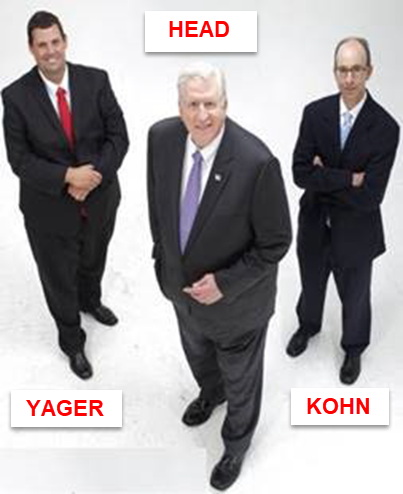
A fully trained DUI lawyer knows how to debunk field sobriety test steps. That skill matters most when a case rests on a jury accepting field sobriety test evidence. Georgia appellate cases let the State win a driving under the influence case on these roadside tests alone. Courts call that charge "Georgia DUI less safe." The tests are unreliable. Georgia law permits this as being justified by you WILLINGLY participating. That stance has held up over three decades of litigation. Field sobriety tests are in NO WAY tied to driving impairment. Your DUI attorney will seek, at pre-trial motions or trial, to neutralize field sobriety tests. That effort may take one or more DUI expert witnesses. They show the judge or jury the "junk science" police officers push. A DUI law firm that focuses on DUI defense is the answer. Atlanta DUI lawyer Bubba Head, with his partners Larry Kohn and ex-cop Cory Yager, aggressively defends a DUI in Georgia.
Named authority helps here. In Olevik v. State, 302 Ga. 228 (2017), the Georgia Supreme Court read the state constitution's self-incrimination clause, Art. I, Sec. I, Para. XVI. That clause protects a person from being forced to perform an incriminating act. Blowing into a breath machine is one such act. In Elliott v. State, 305 Ga. 179 (2019), the Court extended that protection. The State may not use a breath-test refusal as evidence at a criminal trial.
Notice the asymmetry. The protection is strongest against compelled acts. Georgia Court of Appeals decisions treat a test you took voluntarily as evidence. That evidence may show you were a less safe driver under Georgia's DUI statute. That is exactly why officers ask rather than order. Your voluntary participation is what makes the eight walk-and-turn clues usable against you, depending on the facts of the case. A DUI lawyer can explain how this law applies to your own stop.
Several major flaws keep the gaze nystagmus test from being RELIABLE proof of DUI. Almost all officers do the HGN test incorrectly. They hold the stimulus too high, too low, or too close to the person's face. Those errors CREATE nystagmus. They do so even in subjects with zero alcohol in their system. The robustness study shows a 61.1% error rate for a stimulus held 4" or more above eye level.
The nystagmus test begins to reveal "clues" at a very low BAC level, such as 0.04 or even lower. Yet training tells officers that ONLY those at 0.10 or more will show 4 or 6 clues. Georgia's legal limit for an adult driver is 0.08. Under Georgia's chemical test statute, a BAC level of 0.05 grams or less lets the trier of fact infer that the driver was NOT under the influence.
Medical experts confirm that the DUI eye test is overly sensitive. The test shows four (4) or more clues in people above the legal alcohol limit. It shows them in people below it too. That error rate shows why police training misleads. A test done the wrong way is useless, because the officer drops the standard steps. Yet Georgia courts often let it in anyway. Your strongest protection is to hire an experienced DUI lawyer for your criminal case.
NHTSA training on the HGN test is ambiguous. The INSTRUCTOR manual tells officers to ask about eye conditions, defects, and drugs that may trigger HGN. The PARTICIPANT manual used by trainees lacks a reasonable checklist for those pre-existing causes. Officers check for equal pupil size. They also hold the stimulus still at center point to look for "resting nystagmus." Those checks are thin. Only the non-scored "equal tracking" step looks for visible medical problems. No doctor would approve that screening.
On the second scored HGN test, "sustained and distinct nystagmus at maximum deviation," most officers cut short the 4 seconds required. That fails the "standardization" that was supposed to be the benchmark of the NHTSA standardized field sobriety tests. On the final pass, "onset of nystagmus prior to 45 degrees," almost no officers comply with their training. Issues exist in about 90% of DUI arrest videos. NHTSA rules require TWO passes to each side, at a minimum.
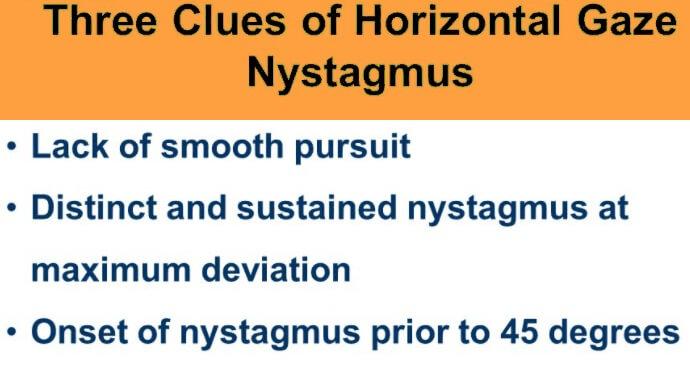
Most larger prosecutor offices require the NHTSA field sobriety test 20-hour practitioner course. They then attempt these "passes" for the HGN test, just like officers learn to do them. Doing it correctly is far harder than you think. For our DUI attorneys, that advanced training is a major key to knowing how to beat a DUI.
They learned a second thing. Done in a precise, standard way, the HGN test is the most accurate of the three standardized field sobriety tests. Officers nickname it the DUI eye test. The 1977 study rated each test on predicting who was 0.10 grams percent or more. The rates were HGN 77%, walk-and-turn 68%, and one-leg-stand 65%. The raw data from that study does not support those rates. The researchers left out some false positives and false negatives. Controlled studies by medical eye specialists, such as Dell'Osso, found more than forty-five OTHER causes of horizontal gaze nystagmus. Any of them can fool an officer. The officer then believes the twitch comes from alcohol.
Dr. Greg Kane, MD, has written often about wrongful convictions. He traces them to "bogus" math claimed for the field sobriety tests in the Burns and Moskowitz studies. Most DUI attorneys have never heard of Dr. Kane, or his great website, www.sfst.us. He works hard to debunk fake science.
Running the three SFSTs 100 times lets a scientist show how much ACCURACY exists for X percent of the time. That is what NHTSA teaches DUI law enforcement officers. Accuracy is more complicated than that answer claims to prove.
The accuracy table on this page comes from NHTSA's original 1977 project. That work was titled Psychophysical Tests for DWI Arrest 1977. The labels used here, by Dr. Kane, are more logically named. In that project each subject produced two TYPES of readings. One was a blood alcohol reading from a breath test device. The other was Field Sobriety Test results. The question boils down to this. What percent of the time did the field sobriety test scores correctly predict the alcohol readings? Sorting the 1977 subjects by test result sets up True Positive, True Negative, False Positive, and False Negative counts.
The TARGET of the field sobriety tests is alcohol measurement. The question is whether the person is at or above the legal alcohol limit. These roadside tests do not and cannot detect impairment from drinking. At a legal seminar, Dr. Marcelline admitted that the field sobriety tests DO NOT prove impairment. They also cannot tell which subjects had certain BAC levels. Yet police officers often claim that the "clues" show IMPAIRMENT. This is false, and your DUI attorney should object and move to strike that testimony.
Dr. Spurgeon Cole, Ph.D., is an expert in "testing and measurement." He co-authored a 1994 peer-reviewed article. It reported a 46% false positive rate for divided attention field sobriety tests. Dr. Burns' team had nearly the same rate at 47%. In the 1977 California study, 47 of the 101 tests were scored as false positives. The Cole study used veteran police officers with a median of nearly 12 years on the job.
That work matters most when you set it beside the clue tally described earlier on this page. The walk-and-turn is a divided attention test scored on eight clues. Two clues are enough for an officer to write down a failure. Suppose the false-positive rate in that article is close to correct. Then many sober subjects get written up as having "failed." The study's design is the part officers rarely hear about. Raters watched video of sober subjects doing normal tasks. They still judged many of them too impaired to drive. That is what the article reported, not an established fact about every case. The clue count is the number; this study is why the number should not be trusted on its own.
Plus, only the HGN is a "psychophysical test," and the other two (WAT and OLS) are divided attention and balance tests. Suppose a person "looks okay" on the WAT and OLS. Suppose the judge also excludes the HGN test at a pre-trial motion. The accused citizen then has a far stronger case. Beyond the basic PRACTITIONER course, our Atlanta DUI attorneys have also passed the NHTSA Field Sobriety Test INSTRUCTOR course. A driver should hire a DUI lawyer with more HGN test training than the officer in the case.
Other insights on this website: Nhtsa DUI Manual, DUI Checkpoints Today near me, Are DUI Checkpoints Legal in Texas, and DUI Checkpoints Tonight.
Field sobriety evidence can be challenged. But someone must review it clue by clue. William C. Head, PC offers a free consultation about your Georgia DUI arrest. Talk with a criminal defense attorney Atlanta drivers can reach directly.
Clients should preserve everything they have. The citation, the arrest report, and any dash-cam or body-cam video matter most. Drivers should write down what they remember about the road surface and its slope. The lighting, the weather, footwear, and any balance problem all matter.
Here is what the review looks for. A lawyer who took the same NHTSA practitioner training as the officer can compare the video to the manual. The manual sets how each of the eight walk-and-turn clues must be given and scored. Small slips from the manual change what a clue is worth.
Call promptly. Georgia sets a short deadline to answer the license suspension that follows a DUI arrest. That clock starts at the arrest. No attorney can predict how a case will end, and past results do not guarantee a similar outcome. We can review your stop honestly and pursue every available defense.
The officer directs you to take nine heel-to-toe steps out, turn with a series of small steps, then take nine heel-to-toe steps back. The nickname comes from that step count. The scoring does not change, and the same eight NHTSA clues apply.
Roadside tests are voluntary in Georgia. Declining them does not by itself trigger a license suspension. The state-administered chemical test requested under implied consent is different, and it does carry license penalties. A lawyer can apply that difference to your stop.
No, a recorded "failure" is one piece of evidence, not a verdict. The State must still prove that alcohol or drugs made you a less safe driver. The test itself may also be challenged or excluded.
Drivers should tell a lawyer right away and gather their medical records. The NHTSA manual cautions against giving this test to people with back, leg, or middle-ear problems. That caution could matter at a motion hearing.