William C. Head, P.C.
Atlanta DUI Law Firm




Driving under the influence (DUI) in Georgia means operating or being in actual physical control of a moving vehicle while impaired by alcohol, drugs, or other intoxicating substances. The statute also covers driving while over the legal blood alcohol limit.
Georgia's DUI laws do not stand alone. A DUI arrest almost always begins when an officer sees a traffic violation first. The stop comes first. The DUI investigation comes second. Both end up on the same citation. This page covers the five Georgia statutes that most often appear together on a DUI citation or arrest report:
Each of these laws carries its own penalty, and each one can be attacked on its own facts. The sections below explain what the state must prove, what a conviction costs, and where the common defenses come from.

Georgia's main DUI statute bars driving or being in actual physical control of a moving vehicle under several theories of impairment. Each theory gives the state a different path to a conviction.
Georgia recognizes two broad categories of DUI. The "less safe" theory does not require a specific blood alcohol concentration (BAC). The state must prove that alcohol, drugs, or another substance made the driver less safe to drive. Officers lean on field sobriety test results, driving behavior, and physical observations to build that case.
The per se theory requires no proof of impairment at all. If a driver's alcohol concentration reaches the legal limit at any time within three hours after driving, that fact alone supports a conviction. Georgia's per se limits are:
A driver can be charged under both theories at the same time. The state only needs to win on one of them. The three-hour window matters more than most people expect. The reading the state uses is not the reading at the moment of driving. The timing of the test is often where a defense begins.

The DUI statute also covers driving under the influence of drugs – illegal drugs and prescription drugs alike. Under the subsection dealing with controlled substances, any amount of marijuana or a controlled substance in the driver's blood or urine may support a charge.
If a person takes a lawfully prescribed medication, the state must prove the drug made them incapable of driving safely. That is a much higher burden than the "any amount" rule. Defense attorneys examine it closely in every prescription-drug case.
Georgia measures prior DUI history over a ten-year lookback period. The clock runs from the dates of the earlier arrests that produced convictions to the date of the current arrest. It does not run from conviction dates. The penalties climb sharply with each conviction:
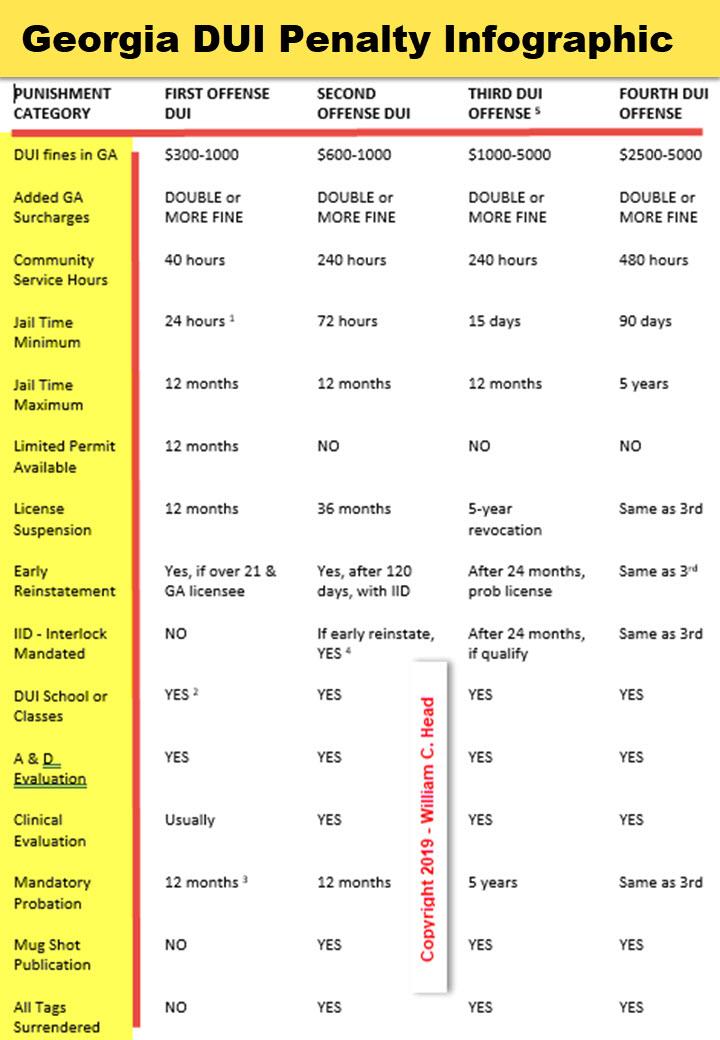
First Offense (Misdemeanor):
Second Offense (Misdemeanor):
Third Offense (High and Aggravated Misdemeanor):
Fourth or Subsequent Offense (Felony):
A second or later conviction within five years carries one more consequence people rarely expect. The clerk of court must publish a notice of conviction in the newspaper that serves as the county's legal organ. The notice carries the photograph, name, and case details. The convicted driver is assessed $25 toward the cost.
The criminal sentence and the driver's license consequence are two separate tracks. A conviction triggers its own suspension under Georgia's license suspension law. That window is five years, not the ten years used for criminal sentencing.
A first conviction within five years brings a 12-month suspension. The driver may apply for early reinstatement after 120 days by completing a risk reduction program and paying the restoration fee.
A second conviction within five years brings a three-year suspension. Reinstatement eligibility is pushed out to 18 months for a DUI. A third conviction within five years is the line that matters most. At that point the driver is treated as a habitual violator, and the license is revoked rather than suspended.
The criminal lookback runs ten years. The license lookback runs five. So a driver can face a "second offense" sentence in court while the licensing side treats the case as a first. Getting that right early changes how a plea is judged.
Driving under the influence while transporting a child under 14 in the vehicle is a separate offense in Georgia – endangering a child by driving under the influence. It does not merge with the DUI count. A driver convicted of both is sentenced separately on each. A single trip with two children in the car can produce two endangerment counts.
Beyond the criminal case, a DUI arrest starts an administrative license suspension proceeding through the Department of Driver Services. This is the deadline that catches people out. It runs while the criminal case is still months away from a first court date.
Under Georgia's implied consent suspension statute, a driver has 30 days from the date the suspension notice is served to request a hearing in writing and remit the $150 filing fee. The notice is normally served at the arrest itself. Miss the deadline and the suspension takes effect on its own, no matter how the criminal case turns out.
The alternative is an ignition interlock device limited driving permit, which the department may issue within the same 30-day window. The permit is valid for one year, and once a year of monitoring is complete the interlock restriction comes off. It is not open to everyone. The driver must be at least 21, hold a valid Georgia license, not hold a commercial license, and have no DUI conviction in the prior five years.
The two options are mutually exclusive. Applying for the interlock permit requires an affidavit waiving the administrative hearing. That choice comes in the first few days of a case, before any evidence has been reviewed. It is one reason drivers call a lawyer right after a DUI arrest.
This offense makes it unlawful for a driver to willfully fail or refuse to stop, or to flee or attempt to elude a pursuing police vehicle or officer, after being given a visual or audible signal to stop. The statute puts conditions on the officer as well. The officer must be in uniform and prominently displaying a badge. The pursuing vehicle must be appropriately marked.
Those conditions are elements of the offense, not technicalities. If the signal or the marking requirement fails, the charge fails with it.
A first offense is not an ordinary misdemeanor. Georgia grades it as a high and aggravated misdemeanor, and the statute sets the numbers itself rather than leaving them to the court:
The charge also becomes a felony – carrying that same $5,000 to $10,000 fine and 12 months to ten years – when the flight involves any of the following:
On top of the sentence, a conviction for using a motor vehicle in fleeing or attempting to elude an officer is on the short list of offenses for which the Department of Driver Services must suspend the license.
This charge commonly appears alongside DUI when a driver sees blue lights and panics. The driver keeps rolling, or turns down a side street, instead of pulling over promptly. When officers finally stop the vehicle they often note signs of impairment and open a DUI investigation. The driver then faces both charges, each with its own penalty.
Prosecutors treat fleeing charges seriously because of the public safety risk. The mandatory minimum fine leaves them little room to discount one. A DUI case with an eluding count attached is materially harder to negotiate down than a DUI standing alone.
Several defenses may apply to this charge.
Identity: If the officer lost visual contact during the pursuit, proving the stopped driver is the same person who fled may be difficult.
Lack of willfulness: The statute requires a willful failure to stop. Say a driver did not realize the signal was meant for them, or was looking for a safe place to pull over. That driver has not willfully fled.
Improper signal, uniform, or marking: If the officer was not in uniform, was not displaying a badge, or was driving an unmarked car, the statutory elements may not be met.
Each defense depends on the specific facts and the available evidence. Dashcam and bodycam footage often decides which way these cases go.
Georgia defines aggressive driving as operating a motor vehicle with the intent to annoy, harass, molest, intimidate, injure, or obstruct another person. Intent aimed at another road user is the heart of the offense.
Aggressive driving is a misdemeanor of a high and aggravated nature. That classification carries a fine of up to $5,000 and up to 12 months in jail. It also limits earned time to four days per month. And it carries 6 points against the Georgia driving record. Reckless driving, by contrast, draws 4.
A single act done with the wrong intent is enough. The statute says the offense includes, without limitation, committing certain other moving violations with that intent, among them:
That structure is what makes the charge different from a simple traffic ticket. The driving conduct may be a three-point moving violation on its own. Adding proof of intent turns the same conduct into a high and aggravated misdemeanor.
Intent is also the element most open to challenge. It is usually proven by inference: how close the vehicles were, how long the behavior lasted, and what the other driver reported. A single abrupt lane change during a DUI stop rarely carries that weight on its own.

The two charges overlap but differ in one key way. Reckless driving requires driving in reckless disregard for the safety of persons or property. It does not require intent directed at a specific person.
Aggressive driving requires that the driver acted with intent to annoy, harass, or intimidate someone in particular. Reckless driving is the lesser of the two on the point schedule and is an ordinary misdemeanor rather than a high and aggravated one.
This distinction matters in plea negotiations. Prosecutors sometimes use an aggressive driving count as leverage and offer to drop it in exchange for a plea on the DUI. An attorney who understands how the two charges interact can weigh whether that trade is actually worth taking.
This statute requires every driver to stay within a single lane as nearly as practicable, and to make sure a lane change can be made safely before starting it. It has five parts:
Georgia's traffic code makes any act it forbids a misdemeanor unless the code says otherwise. This statute says nothing otherwise. A conviction can carry a fine of up to $1,000 and up to 12 months in jail. In practice, a standalone lane violation draws a fine. It falls into the "all other moving violations" category on the state point schedule, which is 3 points.
This violation is one of the most common reasons Georgia officers start stops that end in DUI arrests. An officer sees a vehicle drift over a lane line or weave inside its own lane. The officer turns on the emergency lights. Then the officer notes signs of impairment during the stop.
That sequence makes the lane violation the foundation of the entire DUI prosecution. If the initial stop was not legally justified, a court may suppress everything gathered afterward. That includes field sobriety tests, breath tests, and blood draws. The three-point traffic charge is worth far less than the case that rests on top of it.

The statutory language itself gives the defense its opening. A driver must stay in the lane "as nearly as practicable" – not perfectly, and not at all times. Brief, momentary weaving may not amount to a violation at all. That is especially true on roads with worn markings, uneven surfaces, or heavy crosswinds. Georgia courts have looked closely at whether the driving really established reasonable suspicion for a stop.
Defense attorneys review dashcam footage frame by frame to determine whether the vehicle crossed a lane line or simply drifted near it. If the officer's stated reason for the stop does not hold up, the DUI case built on it may collapse. That is why a lane violation deserves close review in every DUI arrest. It often looks like the smallest charge on the citation and is not.
This statute requires each occupant of the front seat of a passenger vehicle to be restrained by an approved seat safety belt while the vehicle is being operated on a public road, street, or highway. Pickup trucks are inside the definition of a passenger vehicle, so the front-seat rule reaches them too.
The statute lists several exemptions. A driver or passenger who carries a written statement from a physician that they cannot wear a belt for medical or physical reasons is exempt. So is a driver or passenger who keeps stopping and leaving the vehicle, or delivering property, as long as the vehicle stays under 15 miles per hour between stops. The statute also carves out vehicles operating in reverse and vehicles built before 1965. Certain postal and emergency service personnel are exempt as well.

The penalties are modest next to the other offenses on this page:
A seat belt violation is not a criminal act, and the statute expressly says it is not a moving traffic violation for point-schedule purposes. No points attach to the driver's record for either version.
Georgia law also provides that failure to wear a seat belt, in any seat, is not evidence of negligence or causation. That protection keeps a seat belt violation out of a later injury lawsuit as a way to blame the injured occupant.
The seat belt statute is not the whole picture for children. A separate child passenger restraint statute governs children under eight years old, who must be properly restrained in a child passenger restraining system that meets federal standards. Those children must ride in a rear seat. The exception is a vehicle with no suitable rear position, or one where every suitable rear position is already taken by other children.
The fine there is heavier than the seat belt fine. It runs up to $50 for a first violation and up to $100 for a second or later one. In a DUI arrest with children in the car, this charge often appears next to the child endangerment count.
A seat belt violation on its own rarely leads to a full DUI investigation. But officers routinely record an unfastened belt as one more observation in a DUI arrest report. Put it next to the smell of alcohol, slurred speech, or an open container, and the unbuckled belt helps build the officer's account of the stop.
In some cases officers use an observed seat belt violation as the initial reason for a traffic stop. Once at the window, they see signs of impairment and shift into a DUI investigation. Whether that sequence survives legal scrutiny depends on the facts of the individual case.

A Georgia DUI citation rarely involves just one charge. Officers often cite several violations from the same stop. Understanding how the statutes layer together is central to building a defense.
Consider a common sequence. An officer sees a vehicle weave across the fog line, which may be a failure to maintain lane violation. The officer turns on the blue lights. The driver does not stop right away and accelerates briefly, which may support a fleeing or attempting to elude charge. When the officer makes contact, the driver is unbuckled, and the officer notes a seat belt violation. The officer smells alcohol, runs field sobriety tests, and arrests the driver for DUI. If the report describes aggressive lane changes before the stop, the prosecutor may add an aggressive driving count.
Each charge affects the others. If the lane violation did not justify the stop, everything gathered afterward may be suppressed, DUI evidence included. If the fleeing count falls apart because the officer was not in a marked vehicle, the state loses a mandatory minimum fine and its leverage in plea talks. If the aggressive driving count cannot be backed with proof of intent, a high and aggravated misdemeanor drops away.
The penalties also point in different directions. The DUI count drives the license consequence. The fleeing count drives the biggest fine and its own mandatory suspension. The aggressive driving count drives the points. A deal that looks good on one measure can be poor on another. That is why every count on the citation needs its own analysis, not one global plea.
If your citation lists any combination of these statutes, have an attorney review the charges before your court date. Each statute carries its own penalty. The way the charges interact can change the whole defense strategy.
Time matters most on the license side. Georgia's administrative license suspension process gives you 30 days from the date the suspension notice is served to request a hearing or to apply for an ignition interlock device limited driving permit. Those two options are mutually exclusive. Missing the window means an automatic suspension no matter what happens in the criminal case.
William C. Head, PC offers free consultations 24 hours a day, 7 days a week. Call 404-567-5515 to discuss your charges and understand your options.
Driving under the influence is Georgia's primary DUI statute. It prohibits driving or being in actual physical control of a moving vehicle while impaired by alcohol, drugs, or toxic vapors. The statute also sets per se alcohol concentration limits: 0.08 for adults, 0.04 for commercial drivers, and 0.02 for drivers under 21, measured at any time within three hours after driving. Penalties range from a misdemeanor for a first offense to a felony for a fourth or subsequent offense within ten years.
It is a misdemeanor. The driver may face a fine of up to $1,000, up to 12 months in jail, and 3 points on the Georgia driving record. Jail time is uncommon for a standalone lane violation. The charge matters far more in DUI cases, because it often supplies the legal basis for the traffic stop. If the stop was not justified, the DUI evidence gathered afterward may be suppressed.
Not always. A first conviction is a high and aggravated misdemeanor carrying a $1,000 to $5,000 fine and 30 days to 12 months in jail. It becomes a felony on a fourth conviction within ten years, or when the flight involves speeds more than 20 mph over the limit, a collision with a vehicle or pedestrian, an accident, traffic conditions that put the public at risk of serious injury, another serious moving violation, or leaving the state. The felony carries a $5,000 to $10,000 fine and 12 months to ten years.
Aggressive driving means operating a vehicle with the intent to annoy, harass, molest, intimidate, injure, or obstruct another person. Reckless driving requires driving in reckless disregard for safety but does not require intent aimed at a specific person. Aggressive driving is a high and aggravated misdemeanor carrying a fine up to $5,000, up to 12 months in jail, and 6 points on the driving record. Reckless driving carries 4 points.
30 days from the date the suspension notice is served, which is normally the date of arrest. Within that window you must either request an administrative hearing in writing with the $150 filing fee or apply for an ignition interlock device limited driving permit. You cannot do both, and the deadline does not move because your criminal court date is later.
No. The seat belt statute says a violation is not a criminal act and is not a moving traffic violation for point-schedule purposes. The fine is capped at $15 for an adult occupant and $25 for a driver whose minor passenger eight or older is unbelted, with no added fees or surcharges. A separate statute covers children under eight and carries a larger fine.