William C. Head, P.C.
Atlanta DUI Law Firm



Once a police officer makes an arrest for drunk driving, the detained driver is notified of a state law that requires his or her post-arrest compliance with taking a state “forensic” test of breath, blood, or urine. Implied consent laws all carry consequences for NOT complying with implied consent testing.
The minimum sanction is taking away the right to drive for some amount of time. Over half the states add a requirement for only being allowed to drive with an ignition interlock device, that prevents the vehicle from starting if alcohol is detected.
The implied consent law of each state controls all aspects of post-arrest rules and procedures, for police compliance with statutory and constitutional laws.
Some states now have added either a financial assessment and/or jail time, for a DUI refusal. Most states (e.g., Georgia and Alabama) notify the arrested driver verbally of the mandatory testing, but some also provide both verbal and written “warnings” to the arrested DWI-DUI driver (e.g., North Carolina and Kansas).
An implied consent law means that a detained drunk driver is being notified of the legal necessity of submitting to forensic testing, or losing the right to drive, by virtue of administrative driver license suspension (or revocation) action. Because the arresting officer provides a verbal “warning” about the driver’s license consequences of a DUI refusal, many new clients ask our DUI defense lawyers in Atlanta, “What is the implied consent law?”
Our DUI law firm advises them that all states have passed such license suspension laws that are triggered by an officer at a DUI arrest telling the driver that an administrative revocation will take away his or her driving privileges, if the person does not “consent” to the requested testing (breath usually).
The Georgia implied consent law is an essential part of every DUI arrest in Georgia. Yet, police have never taken the time to explain the implied consent definition. It is an obscure law that has been in use in some states for over 70 years, and about 60 years in Georgia. An implied consent law means police inform you of your legal “obligation” (“Georgia law requires you to submit…”) to take INCRIMINATING tests of your blood, breath, or urine. The arresting officer wants to collect evidence to suspend your right to drive. Urine, blood, or breath results can convict you in a criminal case. Police conveniently leave this out of the implied consent notice.
Implied consent laws began to be enacted in the early 1950s, for the purpose of immediately taking away a dangerous driver’s driving license. DUI-DWI drivers were deemed to be such a risk to the public that states could administratively take away or restrict an arrested person’s driving privileges, even before a criminal case was concluded.
In many states (e.g., California, North Carolina, and West Virginia), even if the criminal case gets totally dismissed, these administrative driver’s license sanctions remain in place.
In almost all states, two ways exist to “sanction” the arrested driver:
All states have zero tolerance for alcohol being consumed by drivers under age 21. However, the numeric BAC level varies (from state to state) from 0.00, 0.01 or 0.02, due to the lack of specificity and the inability of breath alcohol testing to reveal the true alcohol level.
Plus, all drivers of a CMV (commercial motor vehicle) are held to a 0.04 grams percent BAC, in every state.
Police have to read the GA implied consent law as soon as possible after the arrestee is in custody. In other states like North Carolina wait until you are in jail, so you can read, and not just hear the implied consent law.
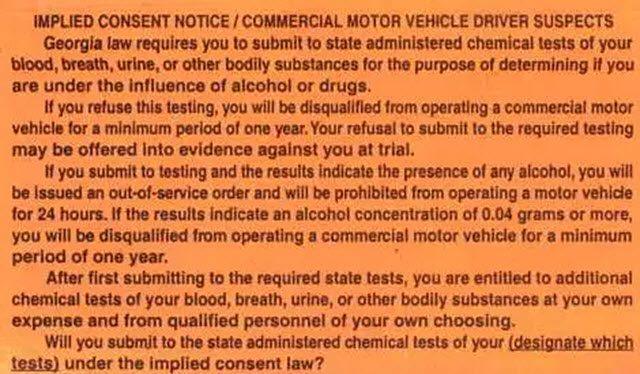

In a nutshell, Georgia implied consent law states you are being asked to submit to testing of your breath, blood, or urine. If you REFUSE implied consent testing, you risk losing all driving privileges and getting a Georgia driver’s license suspension.
Yes, you can. Many people facing a first DUI offense want to say “NO” because police give the implied consent law advisement after your arrest for DUI “less safe.” This fear comes from a mixture of unknowns. People fear being cuffed and going to jail, and they are afraid of needles. Also, people think they will not be placed under arrest for cooperating with police by taking these BAC tests.
Some people arrested for DUI ask to talk to a Georgia DUI attorney immediately, but the arresting officer tells them “no.” While police make DUI-DWI arrests in other states (e.g., NC) the officer will tell the driver when and where they can contact a drunk driving attorney. The Georgia Supreme Court ruled the arrestee can have NO CONTACT with legal counsel before submitting to or refusing the implied consent warning. The court can use this DUI refusal to suspend your driver’s license and is harmful evidence in a DUI case.
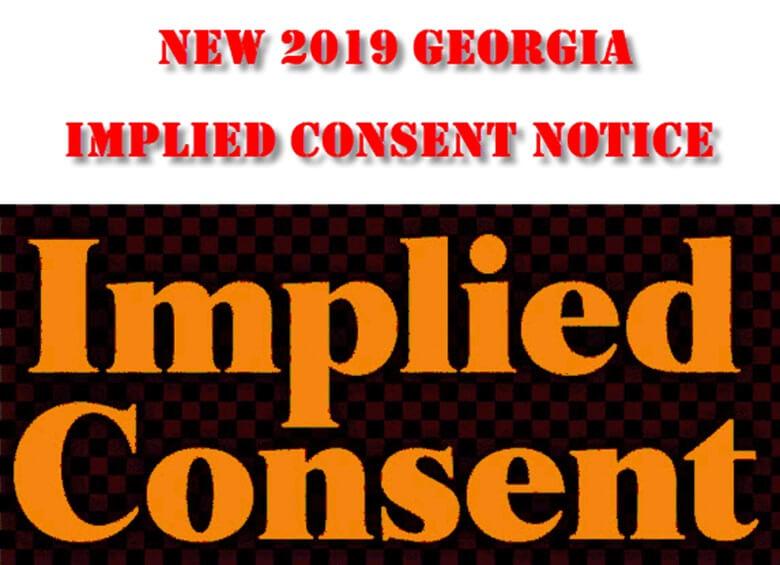
The Georgia implied consent notice is part of statute OCGA 40-5-67.1. Police must read this “warning” to the arrested drunk driver immediately following the arrest. The notice states a refusal to submit will suspend your driver’s license for a full year. The harsh loss of driving privileges makes the GA implied consent law among the toughest in America. Effective July 1, 2017, an alternative softened the GA DUI law, but the consequences are still severe for refusing to submit to the state test. A new Georgia implied consent driver’s license law went into effect on July 1, 2017. The new law allows people to install an ignition interlock device (IID) alternative and drive with an interlock device permit.
Before this new law, a driver faced a total loss of driving privileges. The risk of accepting the interlock alternative is severe, but it is one worth taking. Driving (especially with an Atlanta DUI) is essential to a working person.
Simply stated, when implied consent was conceived 65 years ago, a “legal fiction” was utilized: By driving on our state’s highways, you are deemed to have “consented” to submit to tests of your bodily fluids or breathe, in the event you are arrested for drunk driving or drugged driving.
Each state has (over the past six decades) modified and made more punitive the driver’s license impact, and (in over a dozen states) by adding jail time and or financial penalties, for non-compliance.
Over the many years since its initial enactment, most states have added this type of “notice” to driver’s license application forms, so that the “implied” notice is now an “actual” notice. The laws need to be enacted because a post-arrest detainee is being told that he or she must give MORE incriminatory evidence, with which the state can improve its chances of convicting the arrested driver.
A 2016 decision of the United States Supreme Court has now held that, for Fourth Amendment purposes, a breath alcohol test is not so invasive as to provide federal constitutional protection. Birchfield v. North Dakota, ___ U.S. ___, 136 S. Ct. 2160 (2016).
Hire Our DUI Attorneys! Call a 24-Hour Lawyer for Immediate HELP!
Violation of implied consent puts your right to drive at risk. Why hire a DUI defense attorney with marginal experience and knowledge of how to beat a DUI? Call our office to speak to a DUI specialist, with top credentials. We can even assist you to find a DUI lawyer in another State. Call us now at 404-567-5515.
Click any of the links below to learn more about Georgia’s implied consent law and how it may affect your DUI case: