William C. Head, P.C.
Atlanta DUI Law Firm



By: William C. Head, Criminal Defense Attorney, and ABA Board-Certified DUI Attorney
Georgia’s implied consent law (O.C.G.A. 40-5-67.1) means that by driving on state roads, you automatically agree to take a breath, blood, or urine test if arrested for DUI.
This agreement is not optional—if you refuse testing, your Georgia driver’s license is automatically suspended for 12 months, even if you are never convicted of drunk driving.
Many drivers don’t realize they’ve already agreed to this law. In Georgia, most states include an implied consent notice on driver’s license applications, meaning that when you get a license, you are legally agreeing to submit to chemical testing if arrested for driving under the influence.
Because the arresting officer provides a verbal “warning” about the driver’s license consequences of a DUI refusal, many new clients ask our DUI defense lawyers, “What is the implied consent law?” Below, you’ll find the official Implied Consent Notice Card.
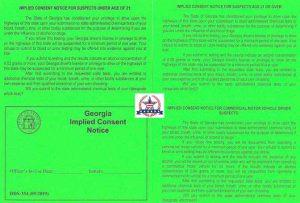
The Georgia implied consent notice is part of statute OCGA 40-5-67.1. Police must read this “warning” immediately after arrest.
The notice states a refusal to submit to a chemical test (either blood, breath, or urine) will suspend your driver’s license for a full year.
However, what the law doesn’t explicitly state is how taking the test can impact your criminal case. The officer’s goal is not only to inform you of your legal obligation but to collect evidence to use against you. An implied consent law means police inform you of your legal “obligation” (“Georgia law requires you to submit…”) to take INCRIMINATING tests of your blood, breath, or urine.
The arresting officer wants to gather test results to suspend your right to drive and secure a conviction.
Below is the exact wording of the Georgia Implied Consent Notice.
“The State of Georgia has conditioned your privilege to drive upon the highways of this state upon your submission to state administered chemical tests of your blood, breath, urine, or other bodily substances for the purpose of determining if you are under the influence of alcohol or drugs. If you refuse this testing, your Georgia driver’s license, or privilege to drive on the highways of this state will be suspended for a minimum period of one year. Your refusal to submit to blood or urine testing may be offered into evidence against you at trial.”

Yes. Georgia implied consent law allows you to request an independent blood, breath, or urine chemical test at your own expense after you take the police blood test. This independent test may help you challenge the police-administered results. This is crucial because Independent tests may reveal lower blood alcohol content levels or errors in police procedure.
Of note: You must clearly state your request to the officer.
Many drivers assume the police test is final, but in reality, there are legal ways to challenge breath and alcohol test results.

Under Georgia’s implied consent laws, a driver who refuses one of these state-administered BAC tests will face a 1-year Automatic License Suspension and won’t be eligible for a limited drivers permit. Unlike adult drivers, you won’t have the option to install an Ignition Interlock Device (IID) and keep driving. This means that a DUI BAC test refusal completely eliminates your ability to drive for a full year–no exceptions.
Georgia has strict, zero-tolerance alcohol laws for those drivers under 21. The legal BAC legal limit is 0.02%, meaning even a small amount of alcohol can lead to a DUI arrest. For perspective, a single beer has an average alcohol content of 0.04%, which is enough to put an underage driver over the legal limit.
Beyond the BAC threshold, the amount of points it takes for license suspension is lower, too. Accumulating four or more points on your license-whether from a DUI or another traffic violation like reckless driving–results in license suspension.
Aside from legal penalties, a DUI arrest can cause you to lose scholarships and future employment opportunities. Since underage drivers face some of the harshest DUI penalties in Georgia, the best way to avoid these severe consequences not get arrested for driving under the influence in the first place.
Those 21 and older may assume they have more leniency–but Georgia’s implied consent law still carries serious consequences for adults as well.
Those drivers over 21 also face a 12-month license suspension for refusing to take a state-administered chemical test.
However, unlike underage drivers, adults may be eligible for a limited driving permit by agreeing to install an ignition Interlock device (not all drivers will qualify) within 30 days of the DUI arrest.
If the driver fails to request an Administrative License Suspension (ALS) hearing or enroll in the Ignition Interlock program, their suspension remains in effect, with no opportunity for license reinstatement during that time.
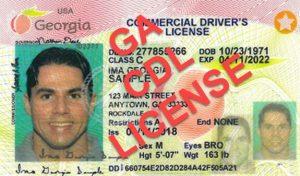
Similarly to drivers under 21, CDL license holders face stricter BAC legal limit rules. The Blood alcohol content limit is 0.04% (half of the 0.08% limit for non-commercial drivers). Even a single violation can result in a one-year CDL suspension. While a second DUI conviction may cause your commercial drivers license to be permanently revoked. Those are just the administrative penalties.

Yes. The Standardized Field Sobriety Tests (SFSTs) are voluntary in Georgia, meaning you can legally refuse to take them without penalty. These tests–including the Horizontal Gaze Nystagmus (Eye Test), Walk-and-Turn, or One-Leg-Stand–are highly subjective and based on bogus science. These tests are only used to justify arrests, not prove impairment.
Refusing an SFST cannot be used against you in court, unlike refusing a breath, blood, or urine test under Georgia’s Implied consent law.
If you’re wondering how to get your license back after a refusal, there are specific steps you must take.
In 2017, Georgia introduced a policy shift that allowed some drivers who refused a chemical test to apply for a restricted ignition interlock permit instead of facing a full 12-month license suspension. Under O.C.G.A. 40-5-64.1, drivers who act within 30 days of arrest can install an ignition interlock device (IID) and maintain limited driving privileges — but this option comes with strict requirements and significant costs–at the DUI arrestee’s sole expense.
Within 30 days of your arrest, you must sign an affidavit seeking to withdraw the DUI refusal in Georgia in exchange for being allowed to install the Interlock for 1 year. If you choose the IID, you waive the right to an ALS hearing, meaning you can’t later challenge the suspension in court.
Opting for the IID permit is a serious financial commitment as well. The total cost–including installation, monthly fees, and removal–can reach $4,000 or more over the full year.

The short answer is NO. Judges have no legal authority to circumvent the Georgia implied consent law, which is controlled by State DUI laws. Your criminal lawyer has to beat a DUI or negotiate a means of keeping you driving, through the administrative license suspension law in Georgia.
Georgia law does not allow hardship or work permits for drivers who refuse a BAC test and lose their administrative license suspension (ALS) hearing. Once the suspension is upheld, no Georgia judge can override it, and no restricted license is available—regardless of hardship.
This issue, of “if suspended administratively” is where the critical importance of hiring a DUI attorney with VAST experience in dealing with these administrative license suspension hearings becomes important.
Georgia appellate case law (Hardison v. Sellers, 171 Ga.App. 327 [1984]) confirms that ALS suspensions for refusal cannot be overturned through judicial intervention.
The only way to avoid a full one-year suspension is to either win the ALS hearing or qualify for the Ignition Interlock Device (IID) program within 30 days of arrest.
The term “hardship license” is part of Georgia law, but is not applicable in this implied consent scenario. In other states, like South Carolina, a DUI lawyer can assist you in getting a “route restricted” driving permit, even with a DUI refusal to be tested, after an initial short period of license suspension.
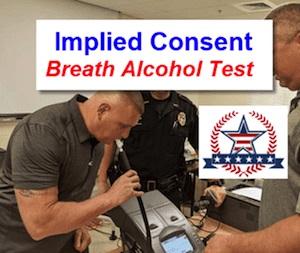
Many people believe refusing a breathalyzer means they’ll look guilty. But in Georgia, the law says otherwise–your refusal cannot be used against you in court. In Elliot v. Georgia (2019), the state Supreme Court ruled that a breath test refusal cannot be used as evidence in a DUI trial.
However, this doesn’t apply to blood or urine tests–if you refuse one of those, that can still be used against you in court.
But what about Miranda Rights? Many DUI suspects believe that police didn’t read them their Miranda rights, their case should be thrown out. However, Miranda does not apply to apply to implied consent warnings because requesting a breath test is not considered an interrogation.
Additionally, Georgia does not allow drivers to consult an attorney before deciding to submit to testing, meaning you must make this decision on your own.
However, field sobriety tests (FSTs) are different. Unlike BAC tests, FSTs are completely voluntary and are not a part of Georgia’s implied consent laws.
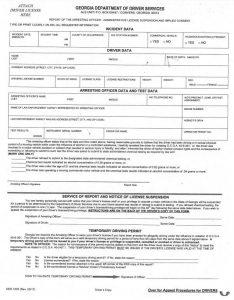
Many drivers assume that DUI is just one legal process, but in Georgia, a DUI arrest causes two separate cases: an Administrative License Suspension and a criminal case.
The criminal case is handled in Court, while the administrative case is handled by the Georgia Department of Driver Services (GA DDS.) So, you need to prepare for both.
Even if a driver isn’t found guilty of driving under the influence GA, they could still lose their license under implied consent rules.

Georgia, like many states, previously allowed warrantless blood draws under implied consent laws.
However, recent U.S. Supreme Court rulings (Mitchell v. Wisconsin in 2019 and Birchfield v. North Carolina in 2016) have restricted this practice, requiring police to obtain a warrant in most cases.
A recent 2025 ruling in South Carolina v. German further reinforced these restrictions, confirming that implied consent laws cannot override the Fourth Amendment’s warrant requirement, except in urgent circumstances like injury or death. While this ruling doesn’t apply directly to Georgia, it signals a legal trend that could influence future cases.

Georgia’s implied consent penalties are among the toughest in the U.S. Like many states, Georgia imposes an automatic license suspension for refusal, but unlike some states (e.g., Florida, South Carolina), Georgia does not offer a hardship permit for DUI refusals.
Some states allow both verbal and written warnings before a chemical test, while Georgia only requires an officer to verbally advise you at the time of the arrest. Additionally, more than half of U.S. states require an Ignition Interlock (IID) for those who wish to regain driving privileges—Georgia makes the program a way to avoid a full one-year suspension.
Some people foolishly try to self-assess their chances of winning a DUI in GA. The operable word here is “FOOLISHLY.” Just reading some of our DUI case histories with:
And you will think you have no chance to beat a DUI in court.
After being arrested for DUI in GA, some people are so depressed that they dwell on their mistake instead of focusing on fighting the charges. Fear of the unknown can be a powerful enemy. Our DUI lawyer partners WELCOME comparing criminal attorney comparisons.

Our law firm has three different law book authors, which is unique in Georgia and possibly in all of America.
A successful defense record for all Atlanta DUI attorneys in the law firm must include possessing the ability to neutralize field sobriety test evidence and finding ways to eliminate breath alcohol test results, especially where the “number” is in excess of the legal alcohol limit. Plus, knowing the LAW is critical, and this entails our DUI attorneys being familiar with every prior appellate decision on Georgia DUI laws and especially Georgia’s implied consent law.
Each DUI attorney in our law office has specialized training in debunking Drug Recognition Officer (DRE) training, challenging GBI blood alcohol or drug tests. Plus, each of our Atlanta DUI lawyers is an INSTRUCTOR of all three NHTSA Standardized Field Sobriety Tests (SFSTs)–training that exceeds most arresting officers’ knowledge.

The best DUI lawyers in Atlanta, Georgia will offer you a FREE attorney consultation at 404-567-5515, explain how their criminal defense attorneys review your DUI case facts and implement a game plan for winning
Click any of the links below to learn more about Georgia’s implied consent law and how it may affect your DUI case: